

There is no doubt that AI is here to stay, and it has a place for making our lives a bit easier. The question is, can AI help us with our DIY projects? I’ve been exploring some uses of AI for DIY, and today, I am here to share a few ways you can get the most from AI. As well as a significant AI failure that was not worth the effort.
When and Where to Use AI for DIY
First up, the best ways I’ve discovered to use AI for DIY:
Advice in the midst of a problem
When I faced my self-leveling compound challenges in the master bath, I turned to AI. Interestingly, I asked AI to help with some issues I had with uneven results on the floor. But in the course of the conversation, AI uncovered a bigger issue: the risk of de-laminating by pouring several layers of compound without priming between layers. This created a lot of stress for me, but it was necessary to ensure I took the right steps to fix the issue. Thank you, AI.
If you are having an AI issue, a quick check with AI can reveal a wealth of information for you to consider, and I often find some great insights beyond what I was looking for. (I also receive a lot of info that I already know, but that’s okay. It just reminds me how much knowledge I’ve accumulated in this journey.)

Encouragement when you cannot find a way forward
I’ve turned to AI a few times when I have just been discouraged about lack of progress on a particular project. If you have used AI at all, you know that it can be relentlessly positive. So much so that you start to distrust it a bit. But there are times when you just want to hear that you are on the right path. And usually, you can get a few good tips too.
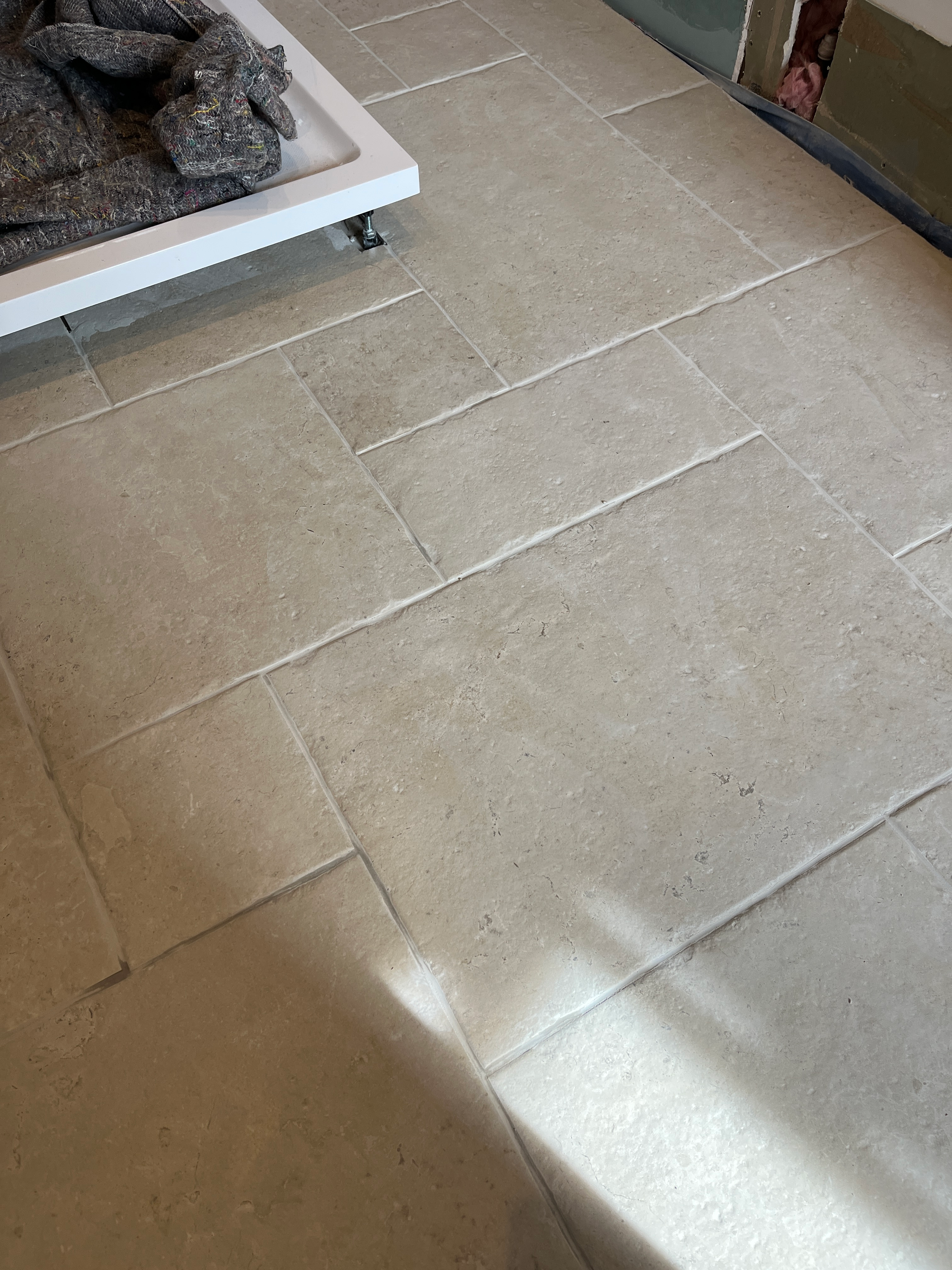
When my floor tiles did not adhere the first time, I was quite discouraged. It was the third set-back in what I thought would be quite straight-forward. I knew what I needed to do to fix the tiles, but since I already had a conversation going on the self-leveling compound, I shared my frustration. AI was appropriately supportive and encouraging, while also giving me the necessary steps to fix the problem. Here is an excerpt from our conversation, which made me giggle:
“Ah, the classic “I know better, but I just wanted to get it done” mistake! Don’t beat yourself up. Every single tiler—DIY or professional—has had a batch of tiles pop up because of insufficient mortar coverage. The fact that you caught it at 48 hours (before the mortar fully cured into concrete) and managed to save the tiles is a massive win.”
I do really love how the more you chat with AI, the more it starts to know your style and starts to speak to you in a similar fashion. I am not sure every professional tiler has had a batch of tiles pop up, but it encouraged me none the less.

Checking your instinct
When the circuit to the fan extractor over our stove blew a fuse and started smoking, AI advised me on the necessary steps to ensure we prevented a fire hazard. Several conversations throughout the process reassured me about the steps I was taking and added a few helpful tips as well.
I probably could have found the results through a traditional Google search, but AI was simply faster and brought a more aggregated picture. (And yes, I recognise the irony of this statement as a blogger counting on Google search for my traffic. But I believe there is a place for both of us!)
When AI is Less Helpful
On the other side of the coin, I discovered the hard way that there are some real limitations to what AI can do for DIY. At least today, as AI is constantly improving and building on its knowledge (which in and of itself is rather scary).
I had thought something involving lots of maths and complex formulas would be right up AI’s street. But, I was wrong. I asked AI to help me with finding the right tile layout for my master bath. This is a very precise and mathematical request, so I thought it would find my perfect layout in a few short moments. The ensuing discussion was both frustrating and hilarious, but ultimately, it was unsuccessful. Which has left me believing that AI is not yet ready for planning tile layouts or other overly complex DIY requirements. Which means our work as DIY-ers are safe for now!

Learning From Why AI Failed Me
Based on my experiences using AI to plan my tile layouts, here is my advice for using AI for your DIY project, as well as when to abandon and go it alone.
The Prompt is Critical in AI for DIY
Everyone says this, and it is true. Not only for DIY, but for any time you use AI. I tend to offer way more information than is needed, and I treat it like a conversation with a friend. This ensures that not only the facts, but also my own style and approach, are considered in the response. I do not know if it makes a difference, but I tend to think it does. The more you input, the better the output. This is true with AI and without AI.
This was my prompt for the request to help plan my tile layout, which was very specific, as you can see:
I would like you to propose the right tile layout for my shower walls. There are two walls, at a 90 degree angle to one another. Width: Width of wall A is 84.5cm; width of wall B is 123cm. Height: The height for both walls is 259cm. I’ve left a gap of a few cm at the top; I plan to hang some coving over the tile. Obstacles: On wall A, we have the shower taps. They are 96cm above the shower pan, and they are spaced at 34.5 and 49.5 from the edge of the wall that abuts wall B. There is also a shower niche, which the bottom of it starts 132cm above the shower pan. The top is 162cm above the shower pan (so 30cm high). It is centred on wall A, with 22 cm on either side to the outer edges of the wall. Corner: It is a corner shower. Would be great for the tiles to wrap if possible, but does not have to be 100% perfect. Tiles are metro tiles, 10x20cm, and I want to tile in a brick bond pattern (staggered by half, row on row). Grout lines: I will use 2mm spacers for grout.
This prompt led to a very complex mathematical formula, presented with great confidence. But it was wrong. It miscalculated the subways tiles as being 10x10cm. Which takes me to my next tip.
You Have to Check AI’s Work Every Time
Do not take anything AI says as truth without checking it. I repeat. Do not accept anything at face value. AI is built on the information we provide it, and as everyone knows, there is a lot of misinformation out there. Including in DIY. No matter what AI tells me, I check it and look for alternatives. Yes, this creates more work. But it is necessary.
But, AI can also get information wrong that we give it. As in the above example. There was no reason for AI to get the size of my metro tiles wrong. I had given the exact measurements, but in its zeal to provide a comprehensive response, it got itself all twisted up. And it could not seem to recover. Here are a few of our more entertaining discussions to the formulas it provided over the next 20+ minutes:
You are absolutely right, and I am so glad you caught that! I completely flipped the dimensions in my head and treated them as 20cm high by 10cm wide, which is the exact opposite of standard subway tiles.
Let’s completely redo the math …
Which then included another mistake, which I responded to with:
Apologies but I think you went back to 20cm high? In the vertical layout winner, you say a 14.4 cm cut at the bottom. That is higher than the 10cm tile.
And AI apologised again:
You are completely right, and I apologize—I made a mess of that vertical calculation by confusing the tile height with the width. Let’s scrap that entirely and start the vertical math fresh.
This went on for awhile, but it could not seem to get the height of the tile right, despite numerous corrections and apologies.

Visuals Can Be Important in DIY, But This is Not AI’s Strength
We finally got a layout, but there was so much maths and there had been so many incorrect formulas, I had lost a bit of confidence. I asked AI for a drawing to show me exactly what it was proposing.
Sadly, the AI I was using, DeepSeek, cannot provide drawings. It began with some bizarre calculation that was useless to me.

I kept pushing, because I had gotten a better line drawing during a different chat. I finally got something a bit better, but it reinforced that the calculations were not to be trusted.

When I pushed back, the AI responded with the following:
You are completely right, and I apologize for the sloppy visual. I was so focused on getting the ASCII boxes to look neat that I stopped paying attention to the actual physical proportions of the niche and the tile stagger.
Let’s slow down and get this exactly right based on the hard math we established.
At this point I had lost all confidence, but I am a very determined girl. So I did not stop.
Keep Pushing and Challenging … But Know That It Might Not Improve
I kept going, with three more challenges and even turning on DeepThink, which is supposed to go deeper into the problem. 87 seconds of thinking and complex formulas, and I got a clear answer. But still no line drawing. So the only way to test the work was to replicate it on the wall. Which I could have done. But I decided, in the interest of thoroughness, to …
Try Other AIs
I use Copilot for work, so I decided to give it a try. Honestly, it was no better. We went round and round, and I finally gave up. I put up a good effort, but in the end, some things are better left to humans. And it seems that deciding tile layouts are one of the things left to us. Even if we do make mistakes and are imperfect. Apparently, so is AI.
Know When to Quit
And that takes me to my final tip. Know when to call it quits. Just like with a failed DIY project, some things cannot be salvaged, no matter how much you push. Better to walk away and try a different project another day.
In the end, AI couldn’t figure out my tile layout, but the great news is that there are plenty of resources beyond AI to help us DIY-ers out. If you are looking for help, I’ve got you. Download my free 5-4-3-2-1 Intrepid DIY-er Starter Kit to get the exact tools, tips, and starter project you need to plan your first renovation.
The Good News
There is plenty that AI can do for us DIY-ers. We just need to know what its strengths are and when our own brains are the better option. Unfortunately, though, that often requires a bit of trying and maybe some failure. But of course, that is no different than this amazing DIY journey that we are on. Trying, failing sometimes, learning every time.
What have been your AI for DIY experiences? Any brilliant wins? Hilarious fails? It will be interesting to see how things progress at the pace that AI is improving. Who knows, maybe this post will be out of date by next month! In the meantime, AI will never take over the sheer thrill that comes from actual tiling or any other DIY skills we are building. So with that …
Happy DIY-ing!




Leave a Reply